The Sovereign Turn in Critical Minerals
A review of government critical-minerals programs worldwide — the instruments, the transactions, what is working, what is not, and what the next phase requires. M. Sumner · Geomorphic AI · 17 pages.
Read the full report below — no PDF download is provided; please link to this page rather than sharing copies.
Full report text
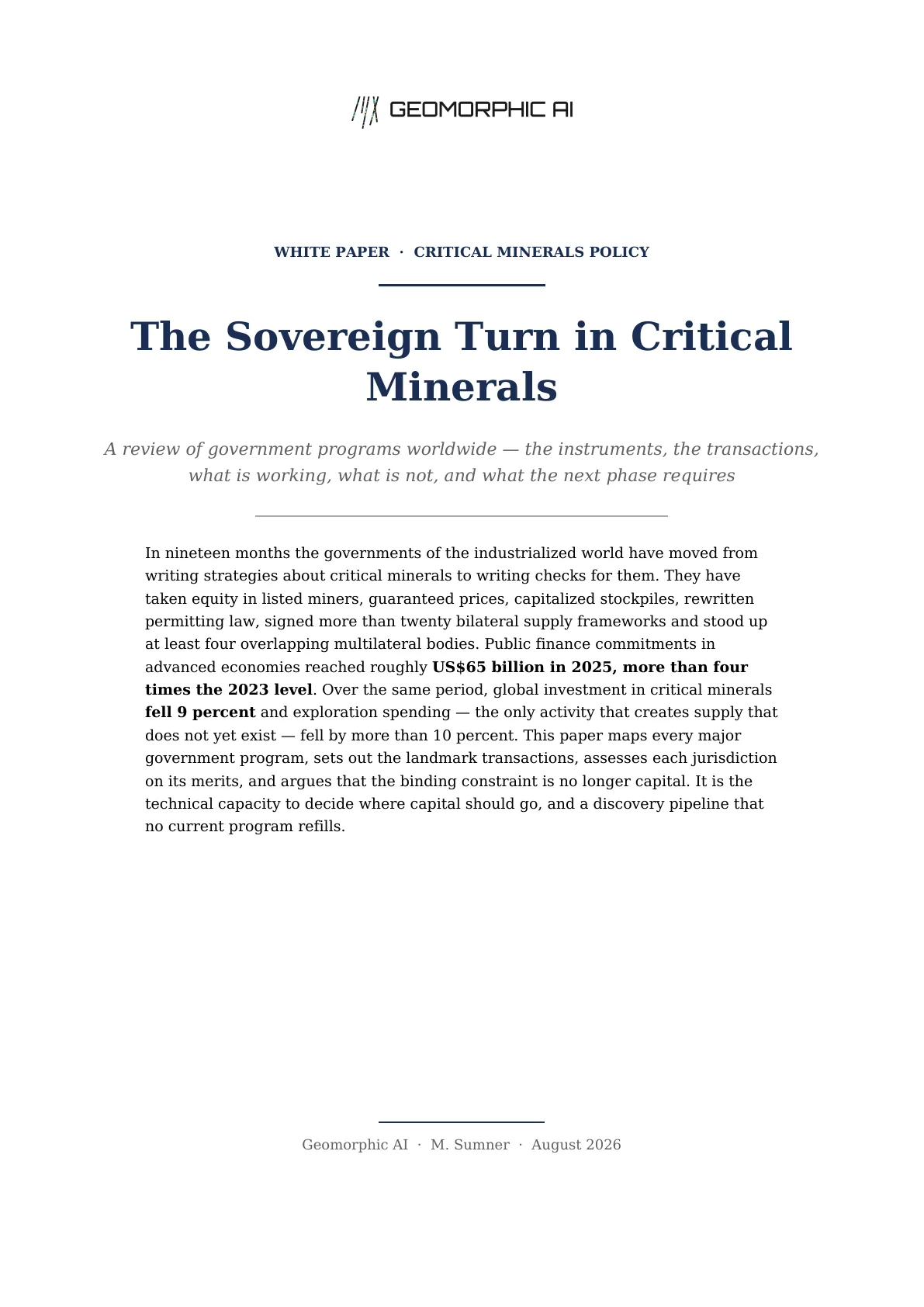
WHITE PAPER · CRITICAL MINERALS POLICY

The Sovereign Turn in Critical
Minerals
A review of government programs worldwide — the instruments, the transactions,
what is working, what is not, and what the next phase requires

In nineteen months the governments of the industrialized world have moved from
writing strategies about critical minerals to writing checks for them. They have
taken equity in listed miners, guaranteed prices, capitalized stockpiles, rewritten
permitting law, signed more than twenty bilateral supply frameworks and stood up
at least four overlapping multilateral bodies. Public finance commitments in
advanced economies reached roughly US$65 billion in 2025, more than four
times the 2023 level. Over the same period, global investment in critical minerals
fell 9 percent and exploration spending — the only activity that creates supply that
does not yet exist — fell by more than 10 percent. This paper maps every major
government program, sets out the landmark transactions, assesses each jurisdiction
on its merits, and argues that the binding constraint is no longer capital. It is the
technical capacity to decide where capital should go, and a discovery pipeline that
no current program refills.

Geomorphic AI · M. Sumner · August 2026

The Sovereign Turn in Critical Minerals

White paper

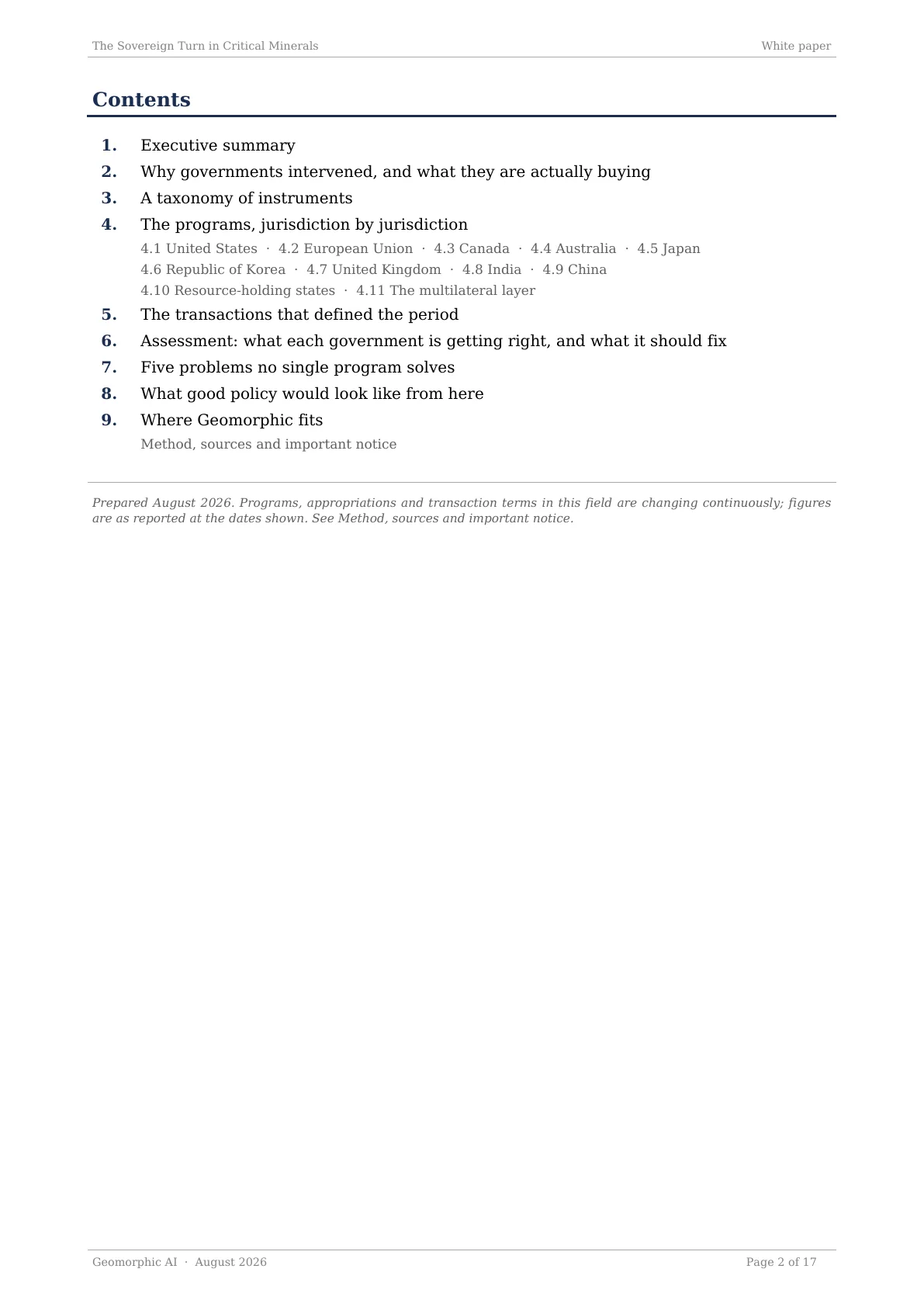
Contents
1.

Executive summary

2.

Why governments intervened, and what they are actually buying

3.

A taxonomy of instruments

4.

The programs, jurisdiction by jurisdiction
4.1 United States · 4.2 European Union · 4.3 Canada · 4.4 Australia · 4.5 Japan
4.6 Republic of Korea · 4.7 United Kingdom · 4.8 India · 4.9 China
4.10 Resource-holding states · 4.11 The multilateral layer

5.

The transactions that defined the period

6.

Assessment: what each government is getting right, and what it should fix

7.

Five problems no single program solves

8.

What good policy would look like from here

9.

Where Geomorphic fits
Method, sources and important notice

Prepared August 2026. Programs, appropriations and transaction terms in this field are changing continuously; figures
are as reported at the dates shown. See Method, sources and important notice.

Geomorphic AI · August 2026

Page 2 of 17

The Sovereign Turn in Critical Minerals

White paper

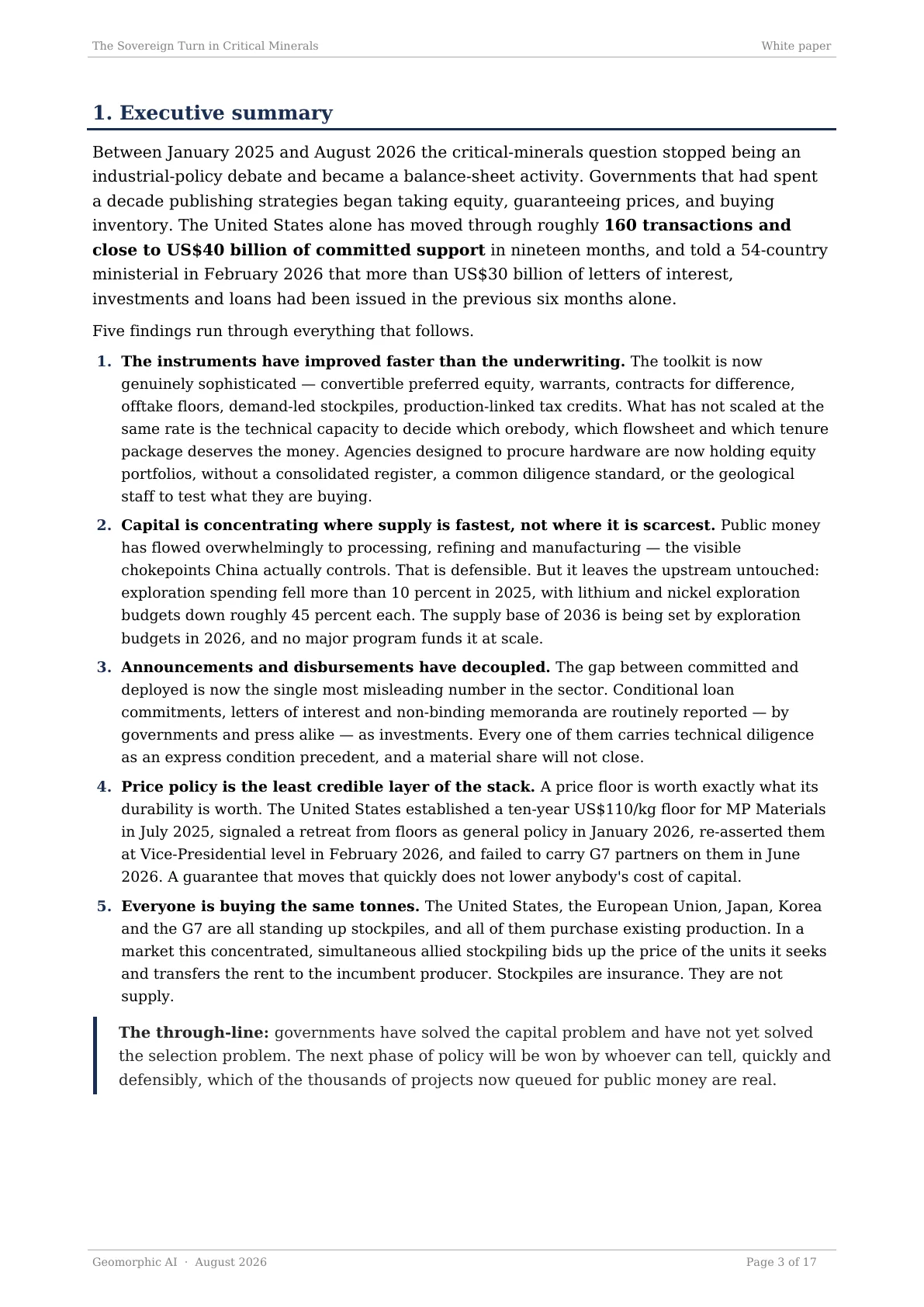
1. Executive summary
Between January 2025 and August 2026 the critical-minerals question stopped being an
industrial-policy debate and became a balance-sheet activity. Governments that had spent
a decade publishing strategies began taking equity, guaranteeing prices, and buying
inventory. The United States alone has moved through roughly 160 transactions and
close to US$40 billion of committed support in nineteen months, and told a 54-country
ministerial in February 2026 that more than US$30 billion of letters of interest,
investments and loans had been issued in the previous six months alone.
Five findings run through everything that follows.
1. The instruments have improved faster than the underwriting. The toolkit is now
genuinely sophisticated — convertible preferred equity, warrants, contracts for difference,
offtake floors, demand-led stockpiles, production-linked tax credits. What has not scaled at the
same rate is the technical capacity to decide which orebody, which flowsheet and which tenure
package deserves the money. Agencies designed to procure hardware are now holding equity
portfolios, without a consolidated register, a common diligence standard, or the geological
staff to test what they are buying.
2. Capital is concentrating where supply is fastest, not where it is scarcest. Public money
has flowed overwhelmingly to processing, refining and manufacturing — the visible
chokepoints China actually controls. That is defensible. But it leaves the upstream untouched:
exploration spending fell more than 10 percent in 2025, with lithium and nickel exploration
budgets down roughly 45 percent each. The supply base of 2036 is being set by exploration
budgets in 2026, and no major program funds it at scale.
3. Announcements and disbursements have decoupled. The gap between committed and
deployed is now the single most misleading number in the sector. Conditional loan
commitments, letters of interest and non-binding memoranda are routinely reported — by
governments and press alike — as investments. Every one of them carries technical diligence
as an express condition precedent, and a material share will not close.
4. Price policy is the least credible layer of the stack. A price floor is worth exactly what its
durability is worth. The United States established a ten-year US$110/kg floor for MP Materials
in July 2025, signaled a retreat from floors as general policy in January 2026, re-asserted them
at Vice-Presidential level in February 2026, and failed to carry G7 partners on them in June
2026. A guarantee that moves that quickly does not lower anybody's cost of capital.
5. Everyone is buying the same tonnes. The United States, the European Union, Japan, Korea
and the G7 are all standing up stockpiles, and all of them purchase existing production. In a
market this concentrated, simultaneous allied stockpiling bids up the price of the units it seeks
and transfers the rent to the incumbent producer. Stockpiles are insurance. They are not
supply.

The through-line: governments have solved the capital problem and have not yet solved
the selection problem. The next phase of policy will be won by whoever can tell, quickly and
defensibly, which of the thousands of projects now queued for public money are real.

Geomorphic AI · August 2026

Page 3 of 17

The Sovereign Turn in Critical Minerals

White paper

2. Why governments intervened, and what they are actually buying
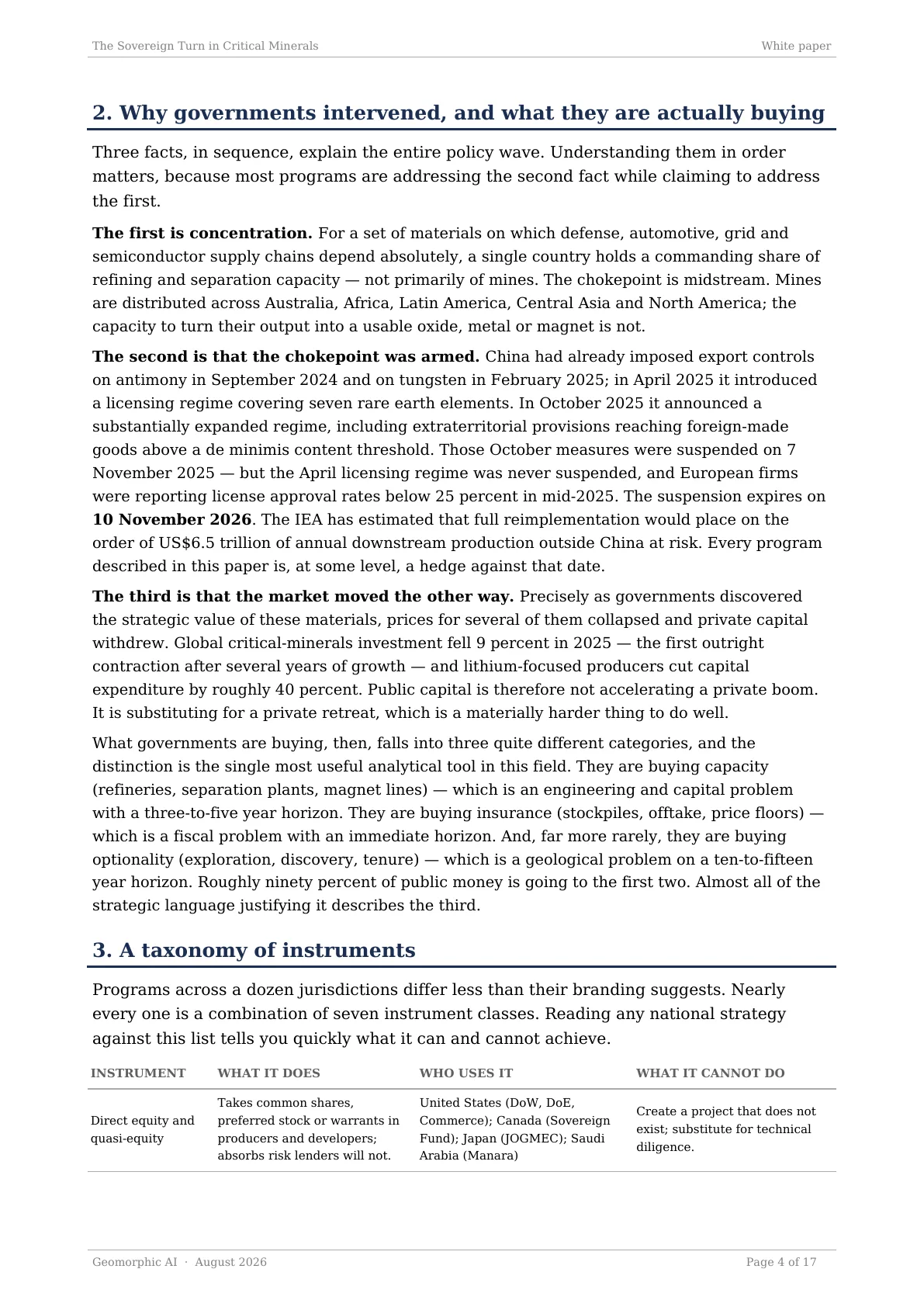
Three facts, in sequence, explain the entire policy wave. Understanding them in order
matters, because most programs are addressing the second fact while claiming to address
the first.
The first is concentration. For a set of materials on which defense, automotive, grid and
semiconductor supply chains depend absolutely, a single country holds a commanding share of
refining and separation capacity — not primarily of mines. The chokepoint is midstream. Mines
are distributed across Australia, Africa, Latin America, Central Asia and North America; the
capacity to turn their output into a usable oxide, metal or magnet is not.
The second is that the chokepoint was armed. China had already imposed export controls
on antimony in September 2024 and on tungsten in February 2025; in April 2025 it introduced
a licensing regime covering seven rare earth elements. In October 2025 it announced a
substantially expanded regime, including extraterritorial provisions reaching foreign-made
goods above a de minimis content threshold. Those October measures were suspended on 7
November 2025 — but the April licensing regime was never suspended, and European firms
were reporting license approval rates below 25 percent in mid-2025. The suspension expires on
10 November 2026. The IEA has estimated that full reimplementation would place on the
order of US$6.5 trillion of annual downstream production outside China at risk. Every program
described in this paper is, at some level, a hedge against that date.
The third is that the market moved the other way. Precisely as governments discovered
the strategic value of these materials, prices for several of them collapsed and private capital
withdrew. Global critical-minerals investment fell 9 percent in 2025 — the first outright
contraction after several years of growth — and lithium-focused producers cut capital
expenditure by roughly 40 percent. Public capital is therefore not accelerating a private boom.
It is substituting for a private retreat, which is a materially harder thing to do well.
What governments are buying, then, falls into three quite different categories, and the
distinction is the single most useful analytical tool in this field. They are buying capacity
(refineries, separation plants, magnet lines) — which is an engineering and capital problem
with a three-to-five year horizon. They are buying insurance (stockpiles, offtake, price floors) —
which is a fiscal problem with an immediate horizon. And, far more rarely, they are buying
optionality (exploration, discovery, tenure) — which is a geological problem on a ten-to-fifteen
year horizon. Roughly ninety percent of public money is going to the first two. Almost all of the
strategic language justifying it describes the third.

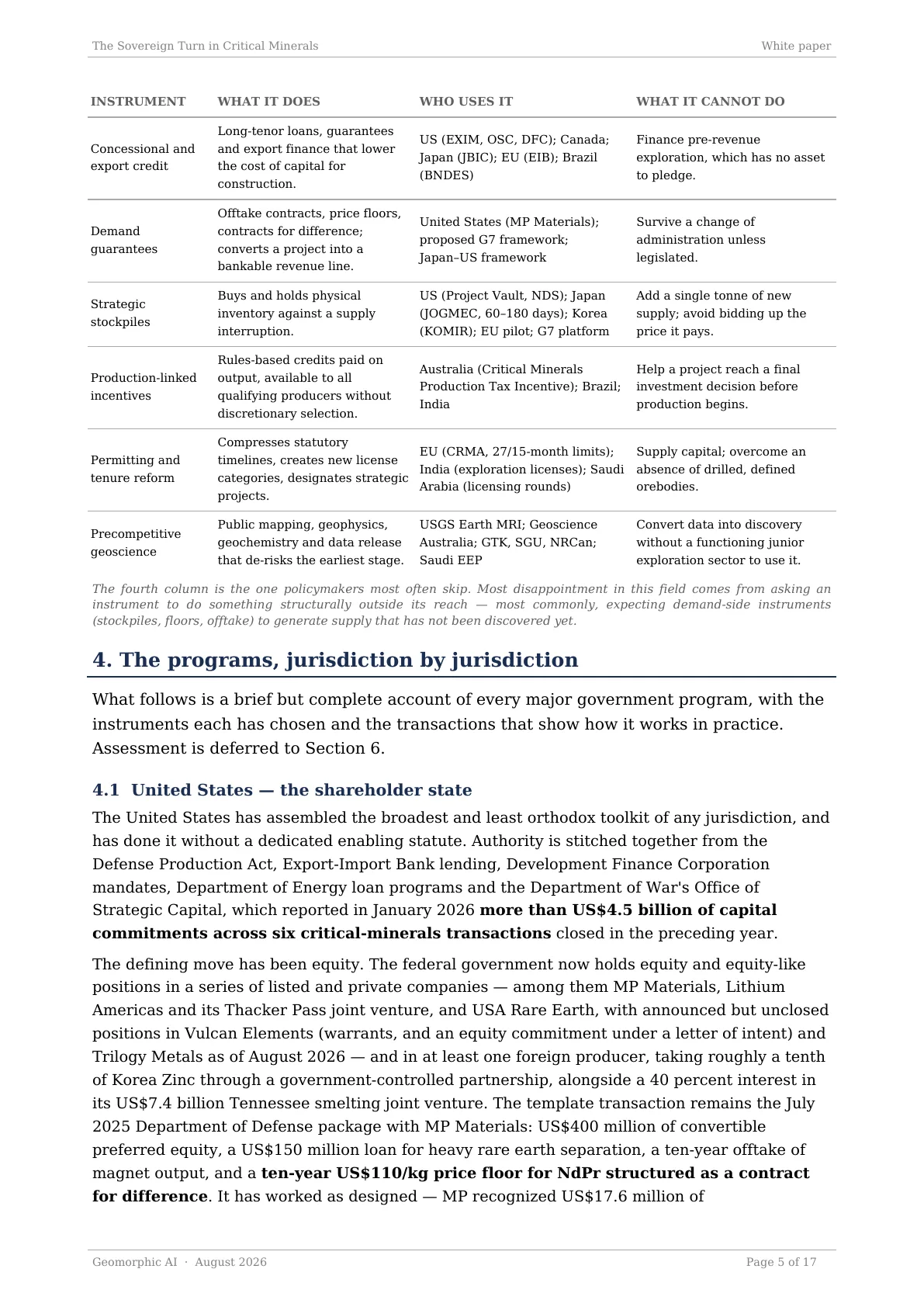
3. A taxonomy of instruments
Programs across a dozen jurisdictions differ less than their branding suggests. Nearly
every one is a combination of seven instrument classes. Reading any national strategy
against this list tells you quickly what it can and cannot achieve.
INSTRUMENT

WHAT IT DOES

WHO USES IT

Takes common shares,

United States (DoW, DoE,

Direct equity and

preferred stock or warrants in

Commerce); Canada (Sovereign

quasi-equity

producers and developers;

Fund); Japan (JOGMEC); Saudi

absorbs risk lenders will not.

Arabia (Manara)

Geomorphic AI · August 2026

WHAT IT CANNOT DO
Create a project that does not
exist; substitute for technical
diligence.

Page 4 of 17

The Sovereign Turn in Critical Minerals

INSTRUMENT

WHAT IT DOES

WHO USES IT

WHAT IT CANNOT DO

US (EXIM, OSC, DFC); Canada;

Finance pre-revenue

Japan (JBIC); EU (EIB); Brazil

exploration, which has no asset

(BNDES)

to pledge.

United States (MP Materials);

Survive a change of

proposed G7 framework;

administration unless

Japan–US framework

legislated.

Buys and holds physical

US (Project Vault, NDS); Japan

Add a single tonne of new

inventory against a supply

(JOGMEC, 60–180 days); Korea

supply; avoid bidding up the

interruption.

(KOMIR); EU pilot; G7 platform

price it pays.

Australia (Critical Minerals

Help a project reach a final

Production Tax Incentive); Brazil;

investment decision before

India

production begins.

EU (CRMA, 27/15-month limits);

Supply capital; overcome an

India (exploration licenses); Saudi

absence of drilled, defined

Arabia (licensing rounds)

orebodies.

Public mapping, geophysics,

USGS Earth MRI; Geoscience

Convert data into discovery

geochemistry and data release

Australia; GTK, SGU, NRCan;

without a functioning junior

that de-risks the earliest stage.

Saudi EEP

exploration sector to use it.

Long-tenor loans, guarantees
Concessional and

and export finance that lower

export credit

the cost of capital for
construction.
Offtake contracts, price floors,

Demand

contracts for difference;

guarantees

converts a project into a
bankable revenue line.

Strategic
stockpiles

Rules-based credits paid on
Production-linked

output, available to all

incentives

qualifying producers without
discretionary selection.
Compresses statutory

Permitting and

timelines, creates new license

tenure reform

categories, designates strategic
projects.

Precompetitive
geoscience

White paper

The fourth column is the one policymakers most often skip. Most disappointment in this field comes from asking an
instrument to do something structurally outside its reach — most commonly, expecting demand-side instruments
(stockpiles, floors, offtake) to generate supply that has not been discovered yet.

4. The programs, jurisdiction by jurisdiction
What follows is a brief but complete account of every major government program, with the
instruments each has chosen and the transactions that show how it works in practice.
Assessment is deferred to Section 6.

4.1 United States — the shareholder state
The United States has assembled the broadest and least orthodox toolkit of any jurisdiction, and
has done it without a dedicated enabling statute. Authority is stitched together from the
Defense Production Act, Export-Import Bank lending, Development Finance Corporation
mandates, Department of Energy loan programs and the Department of War's Office of
Strategic Capital, which reported in January 2026 more than US$4.5 billion of capital
commitments across six critical-minerals transactions closed in the preceding year.
The defining move has been equity. The federal government now holds equity and equity-like
positions in a series of listed and private companies — among them MP Materials, Lithium
Americas and its Thacker Pass joint venture, and USA Rare Earth, with announced but unclosed
positions in Vulcan Elements (warrants, and an equity commitment under a letter of intent) and
Trilogy Metals as of August 2026 — and in at least one foreign producer, taking roughly a tenth
of Korea Zinc through a government-controlled partnership, alongside a 40 percent interest in
its US$7.4 billion Tennessee smelting joint venture. The template transaction remains the July
2025 Department of Defense package with MP Materials: US$400 million of convertible
preferred equity, a US$150 million loan for heavy rare earth separation, a ten-year offtake of
magnet output, and a ten-year US$110/kg price floor for NdPr structured as a contract
for difference. It has worked as designed — MP recognized US$17.6 million of

Geomorphic AI · August 2026

Page 5 of 17

The Sovereign Turn in Critical Minerals

White paper

price-protection income in the second quarter of 2026, against NdPr production up 41 percent
year on year.
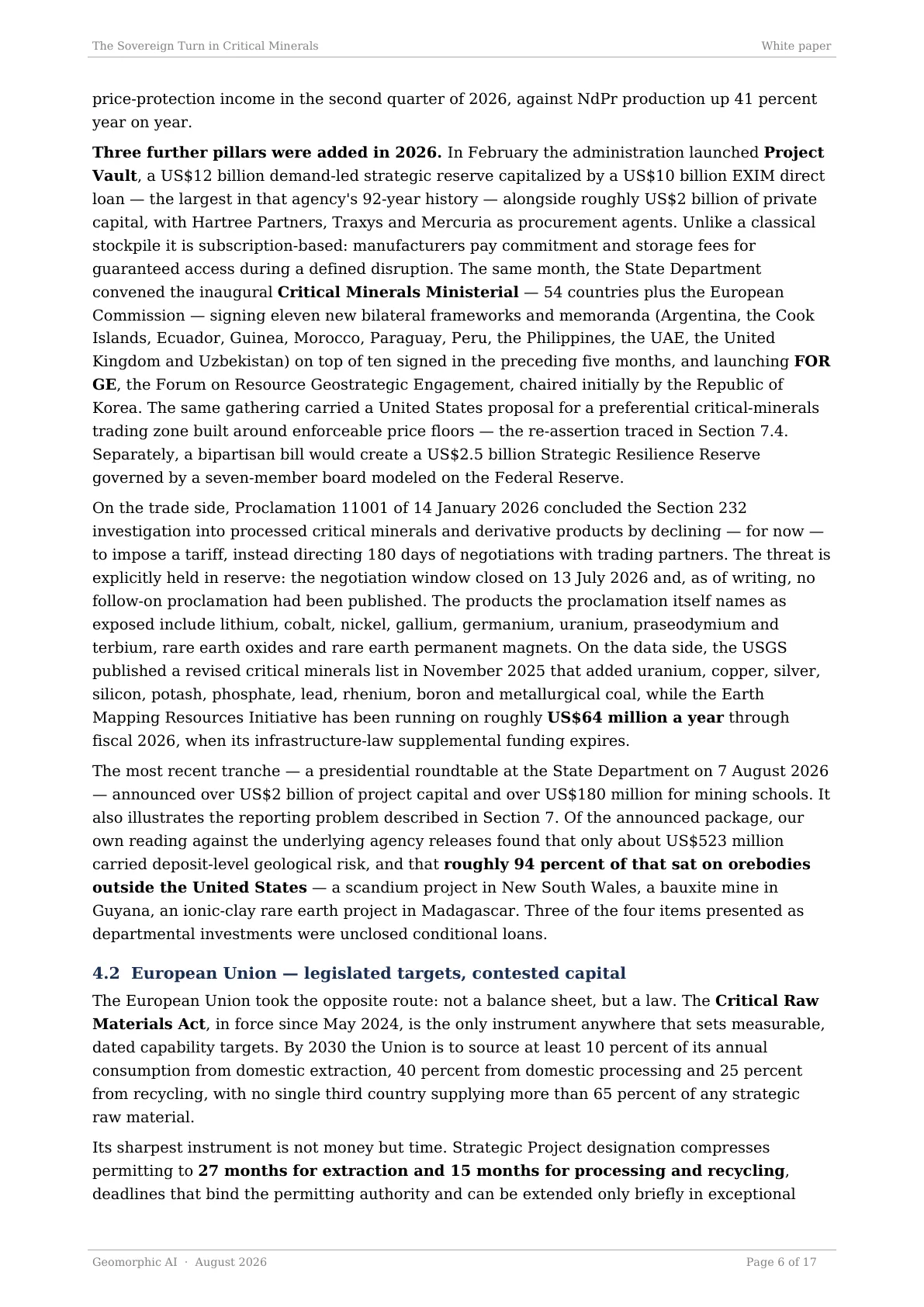
Three further pillars were added in 2026. In February the administration launched Project
Vault, a US$12 billion demand-led strategic reserve capitalized by a US$10 billion EXIM direct
loan — the largest in that agency's 92-year history — alongside roughly US$2 billion of private
capital, with Hartree Partners, Traxys and Mercuria as procurement agents. Unlike a classical
stockpile it is subscription-based: manufacturers pay commitment and storage fees for
guaranteed access during a defined disruption. The same month, the State Department
convened the inaugural Critical Minerals Ministerial — 54 countries plus the European
Commission — signing eleven new bilateral frameworks and memoranda (Argentina, the Cook
Islands, Ecuador, Guinea, Morocco, Paraguay, Peru, the Philippines, the UAE, the United
Kingdom and Uzbekistan) on top of ten signed in the preceding five months, and launching FOR
GE, the Forum on Resource Geostrategic Engagement, chaired initially by the Republic of
Korea. The same gathering carried a United States proposal for a preferential critical-minerals
trading zone built around enforceable price floors — the re-assertion traced in Section 7.4.
Separately, a bipartisan bill would create a US$2.5 billion Strategic Resilience Reserve
governed by a seven-member board modeled on the Federal Reserve.
On the trade side, Proclamation 11001 of 14 January 2026 concluded the Section 232
investigation into processed critical minerals and derivative products by declining — for now —
to impose a tariff, instead directing 180 days of negotiations with trading partners. The threat is
explicitly held in reserve: the negotiation window closed on 13 July 2026 and, as of writing, no
follow-on proclamation had been published. The products the proclamation itself names as
exposed include lithium, cobalt, nickel, gallium, germanium, uranium, praseodymium and
terbium, rare earth oxides and rare earth permanent magnets. On the data side, the USGS
published a revised critical minerals list in November 2025 that added uranium, copper, silver,
silicon, potash, phosphate, lead, rhenium, boron and metallurgical coal, while the Earth
Mapping Resources Initiative has been running on roughly US$64 million a year through
fiscal 2026, when its infrastructure-law supplemental funding expires.
The most recent tranche — a presidential roundtable at the State Department on 7 August 2026
— announced over US$2 billion of project capital and over US$180 million for mining schools. It
also illustrates the reporting problem described in Section 7. Of the announced package, our
own reading against the underlying agency releases found that only about US$523 million
carried deposit-level geological risk, and that roughly 94 percent of that sat on orebodies
outside the United States — a scandium project in New South Wales, a bauxite mine in
Guyana, an ionic-clay rare earth project in Madagascar. Three of the four items presented as
departmental investments were unclosed conditional loans.

4.2 European Union — legislated targets, contested capital
The European Union took the opposite route: not a balance sheet, but a law. The Critical Raw
Materials Act, in force since May 2024, is the only instrument anywhere that sets measurable,
dated capability targets. By 2030 the Union is to source at least 10 percent of its annual
consumption from domestic extraction, 40 percent from domestic processing and 25 percent
from recycling, with no single third country supplying more than 65 percent of any strategic
raw material.
Its sharpest instrument is not money but time. Strategic Project designation compresses
permitting to 27 months for extraction and 15 months for processing and recycling,
deadlines that bind the permitting authority and can be extended only briefly in exceptional

Geomorphic AI · August 2026

Page 6 of 17

The Sovereign Turn in Critical Minerals

White paper

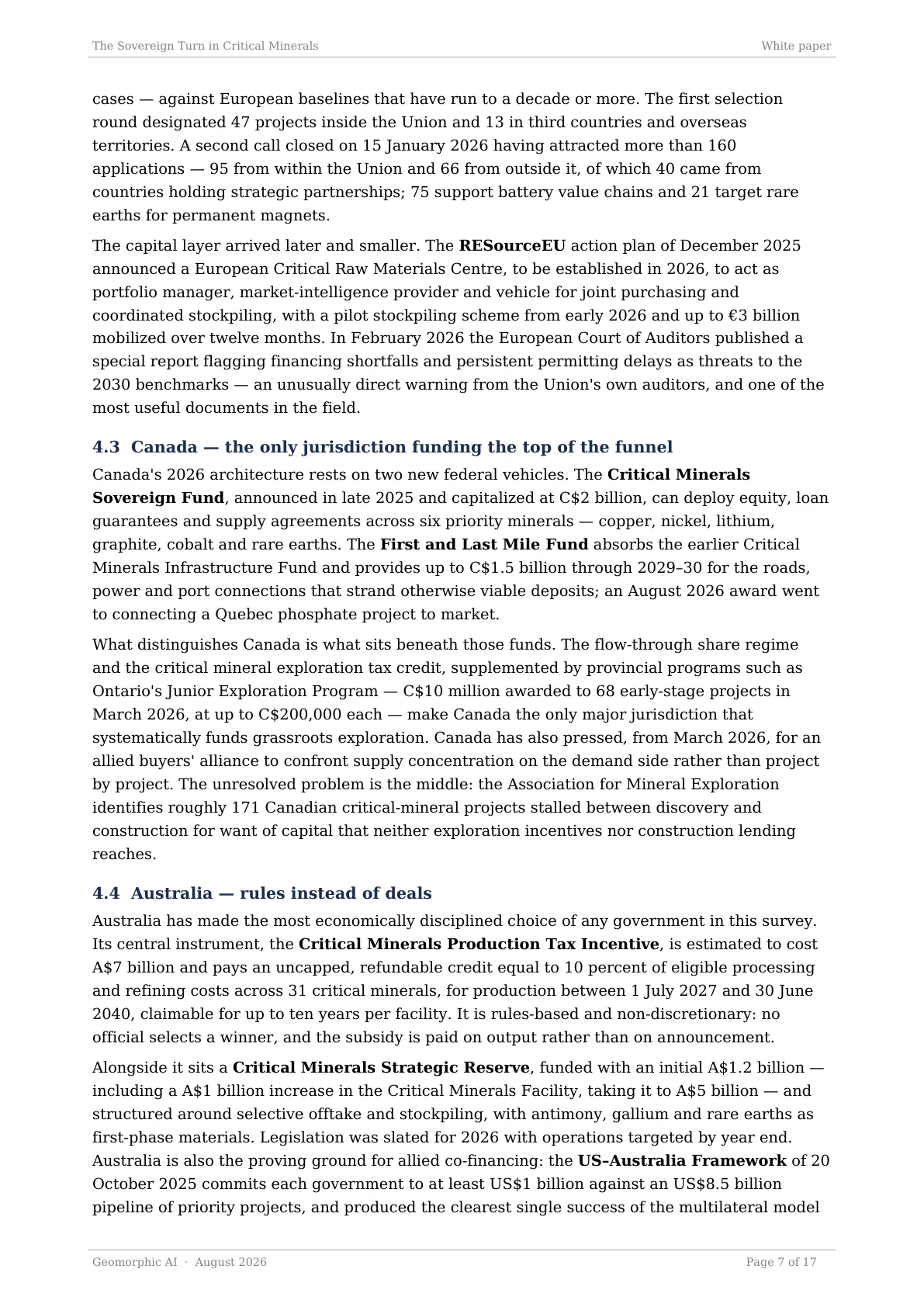
cases — against European baselines that have run to a decade or more. The first selection
round designated 47 projects inside the Union and 13 in third countries and overseas
territories. A second call closed on 15 January 2026 having attracted more than 160
applications — 95 from within the Union and 66 from outside it, of which 40 came from
countries holding strategic partnerships; 75 support battery value chains and 21 target rare
earths for permanent magnets.
The capital layer arrived later and smaller. The RESourceEU action plan of December 2025
announced a European Critical Raw Materials Centre, to be established in 2026, to act as
portfolio manager, market-intelligence provider and vehicle for joint purchasing and
coordinated stockpiling, with a pilot stockpiling scheme from early 2026 and up to €3 billion
mobilized over twelve months. In February 2026 the European Court of Auditors published a
special report flagging financing shortfalls and persistent permitting delays as threats to the
2030 benchmarks — an unusually direct warning from the Union's own auditors, and one of the
most useful documents in the field.

4.3 Canada — the only jurisdiction funding the top of the funnel
Canada's 2026 architecture rests on two new federal vehicles. The Critical Minerals
Sovereign Fund, announced in late 2025 and capitalized at C$2 billion, can deploy equity, loan
guarantees and supply agreements across six priority minerals — copper, nickel, lithium,
graphite, cobalt and rare earths. The First and Last Mile Fund absorbs the earlier Critical
Minerals Infrastructure Fund and provides up to C$1.5 billion through 2029–30 for the roads,
power and port connections that strand otherwise viable deposits; an August 2026 award went
to connecting a Quebec phosphate project to market.
What distinguishes Canada is what sits beneath those funds. The flow-through share regime
and the critical mineral exploration tax credit, supplemented by provincial programs such as
Ontario's Junior Exploration Program — C$10 million awarded to 68 early-stage projects in
March 2026, at up to C$200,000 each — make Canada the only major jurisdiction that
systematically funds grassroots exploration. Canada has also pressed, from March 2026, for an
allied buyers' alliance to confront supply concentration on the demand side rather than project
by project. The unresolved problem is the middle: the Association for Mineral Exploration
identifies roughly 171 Canadian critical-mineral projects stalled between discovery and
construction for want of capital that neither exploration incentives nor construction lending
reaches.

4.4 Australia — rules instead of deals
Australia has made the most economically disciplined choice of any government in this survey.
Its central instrument, the Critical Minerals Production Tax Incentive, is estimated to cost
A$7 billion and pays an uncapped, refundable credit equal to 10 percent of eligible processing
and refining costs across 31 critical minerals, for production between 1 July 2027 and 30 June
2040, claimable for up to ten years per facility. It is rules-based and non-discretionary: no
official selects a winner, and the subsidy is paid on output rather than on announcement.
Alongside it sits a Critical Minerals Strategic Reserve, funded with an initial A$1.2 billion —
including a A$1 billion increase in the Critical Minerals Facility, taking it to A$5 billion — and
structured around selective offtake and stockpiling, with antimony, gallium and rare earths as
first-phase materials. Legislation was slated for 2026 with operations targeted by year end.
Australia is also the proving ground for allied co-financing: the US–Australia Framework of 20
October 2025 commits each government to at least US$1 billion against an US$8.5 billion
pipeline of priority projects, and produced the clearest single success of the multilateral model

Geomorphic AI · August 2026

Page 7 of 17

The Sovereign Turn in Critical Minerals

White paper

— a final investment decision, taken in July 2026 by Alcoa with the Australian, United States
and Japanese governments, on a gallium facility at the Wagerup alumina refinery in Western
Australia, targeting 100 tonnes a year, roughly 10 percent of global demand. Even here the
caveat travels: the government capital was announced as a non-binding agreement funding a
special-purpose vehicle — the pattern Section 7.2 describes.

4.5 Japan — decades of the same policy
Japan is the only country in this survey whose critical-minerals policy predates the current
alarm by decades, and it shows in the institutional design. JOGMEC combines four functions
that are elsewhere scattered across agencies: equity co-investment in overseas mines and
smelters alongside Japanese trading houses, subsidized financing of rare-metal purchases,
statutory stockpiling, and technical and exploration support. The stockpile mandate covers 34
rare metals, and the 2020 International Resource Strategy set targets of 60 days of supply for
standard-risk minerals and up to 180 days for those with elevated geopolitical exposure, with
rare earths in the higher tier.
The 2026 posture is incremental rather than dramatic: a fiscal 2026 allocation of ¥37.9 billion
(about US$238 million) for collection, processing and extraction infrastructure aimed at
recovering rare earths and rare metals from domestic waste streams, and JOGMEC
commitments such as up to ¥5.46 billion into a Toyota Tsusho special-purpose vehicle for heavy
rare earth supply from Namibia. Japan's larger 2026 move was diplomatic: the US–Japan
Framework for Securing the Supply of Critical Minerals and Rare Earths, signed 28 October
2025, establishing joint project financing, coordinated stockpiling, and a Critical Minerals
Supply Security Rapid Response Group run jointly by the Department of Energy and METI,
followed by a bilateral investment ministerial in Tokyo in March 2026. Japan is also a
co-financier of the Wagerup gallium project.

4.6 Republic of Korea — an eight-day service-level commitment
Korea has stockpiled minerals since 1967, through the Public Procurement Service and the
predecessors of today's Korea Mine Rehabilitation and Mineral Resources Corporation
(KOMIR), and organizes its strategy around three pillars: overseas resource development,
stockpiling and recycling. Its distinguishing feature is operational rather than financial — Korea
has committed to a rapid distribution system capable of delivering stockpiled material to a
domestic manufacturer within eight days. No other government has published an equivalent
service level, and the difference between holding inventory and being able to move it is the
difference between a stockpile and a symbol.
In February 2026 the Ministry of Trade, Industry and Energy released Korea's first integrated
rare earth supply-chain strategy, covering upstream resource development, midstream
separation and purification, and downstream permanent magnet production, supported by,
among other instruments, a pre-existing 250-billion-won supply-chain stabilization fund
established in October 2025. Korea chairs FORGE in its opening period, and Korean industrial
capital is itself now an instrument of allied policy: Korea Zinc's Tennessee smelting joint
venture is part-owned by the United States government.

4.7 United Kingdom — a partnership strategy without a balance sheet
The United Kingdom's Vision 2035 critical minerals strategy, published in November 2025, is
candid about the country's position: limited domestic geology, real strength in refining,
recycling, materials science and standards, and therefore a strategy built primarily on
international partnership. Priority partners are named as the United States, the European

Geomorphic AI · August 2026

Page 8 of 17

The Sovereign Turn in Critical Minerals

White paper

Union, Canada, Australia, India, Japan and Saudi Arabia, and the UK signed a bilateral
framework with the United States at the February 2026 ministerial. It is a coherent read of
national comparative advantage. It is also the least capitalized program of any G7 member, and
depends on other jurisdictions' money to deliver the supply it intends to process.

4.8 India — converting unlicensed geology into licensed ground
The National Critical Mineral Mission, launched in 2025, rests on the most structurally
interesting reform in this survey, because India changed the legal architecture rather than the
funding: a 2023 amendment to the mining law created a distinct Exploration Licence category
permitting systematic exploration of deep-seated and critical minerals by private as well as
public entities — a category the country previously lacked — and India has been auctioning
ground at pace. By mid-2026, 56 of 88 unique blocks offered had been successfully auctioned, a
conversion rate above 63 percent, and exploration license blocks auctioned reached 11, the
latest tranche extending the regime into Arunachal Pradesh, Uttar Pradesh and Odisha for the
first time; a seventh tranche of 19 blocks was launched in March 2026. India is simultaneously
buying diversification abroad, signing a critical minerals and rare earths memorandum of
understanding with Brazil in February 2026 and participating in the Quad initiative's US$20
billion mobilization target.

4.9 China — the program everyone else is responding to
China is not conducting a critical-minerals program in the sense the other entries describe; it is
operating the outcome of one, run continuously for a quarter of a century. One count puts
Chinese state-backed financing of critical-minerals projects across the developing world at
roughly US$57 billion between 2000 and 2021 — patient, spread across the full chain, and
concentrated in the unglamorous middle: separation, refining, metallurgy and magnet-making,
the stages with poor returns and high technical barriers that Western capital declined to fund.
The instruments now in use are regulatory rather than financial. The April 2025 licensing
regime over seven rare earth elements remains in force and has never been suspended; the
earlier controls on antimony (September 2024) and tungsten (February 2025) likewise stand;
and the October 2025 package added extraterritorial reach over foreign-manufactured goods
containing controlled material above a de minimis threshold. Suspending that package for a
year, rather than repealing it, is itself the instrument: it converts a trade dispute into a
permanent licensing architecture, with approval rates as the dial. Reported price movements of
up to sixfold in tungsten — with gallium and heavy rare earths running around five times
Chinese domestic prices in Europe — and mid-2025 European approval rates below a quarter,
indicate how finely that dial can be turned. The suspension lapses on 10 November 2026, with
extension, selective reinstatement and full reimposition all live possibilities.

4.10 Resource-holding states — value capture as industrial policy
A parallel and often overlooked policy wave is running in the countries that hold the geology. Its
logic is the mirror image of the consuming states': not security of supply, but capture of margin.
• Indonesia. The most advanced example of forced downstreaming, or hilirisasi. Raw nickel
exports were banned from 2019–20 and bauxite and copper concentrate followed, on the
explicit theory that denying feedstock compels domestic processing investment. It has largely
worked in tonnage terms: 13 downstream projects worth some US$7.2 billion (Rp116 trillion)
— five of them mineral processing — broke ground in April 2026, and bauxite downstream
investment reached Rp40.1 trillion (about US$2.2 billion) in the second quarter of 2026, up 193
percent quarter on quarter. From 1 September 2026 exports of coal, palm oil and ferroalloy
products are routed through a centralized state entity, Danantara Sumberdaya Indonesia, with
Geomorphic AI · August 2026

Page 9 of 17

The Sovereign Turn in Critical Minerals

White paper

a wider commodity scope signaled.
• Democratic Republic of the Congo. An outright cobalt export ban in February 2025 was
replaced by a quota system — announced in September, effective from mid-October — capping
2026 exports at 96,600 tonnes — less than half of 2024 output — to force onshore refining. The
United States signed a Strategic Partnership Agreement in December 2025, and in February
2026 Glencore and the US-backed Orion Critical Mineral Consortium signed a memorandum
over a potential DRC asset acquisition. The associated infrastructure play, the Lobito Corridor
through Angola to the Zambian and Congolese Copperbelt, has drawn a US$553 million loan
from the DFC, up to US$200 million from the Development Bank of Southern Africa and over
€2 billion mobilized by the European Union and its member states.
• Chile and Argentina. Chile's National Lithium Strategy places the state at the center of any
deposit deemed strategic; its centerpiece, the Codelco–SQM joint venture NovaAndino Litio,
cleared its final approvals and was formalized in December 2025, and now operates the Salar
de Atacama, forecast at around 12 percent of global mined lithium in 2026, with further salars
to follow through state operating contracts and direct awards. Argentina has run the opposite
experiment: the RIGI regime, introduced in 2024, offers 30 years of tax, customs,
foreign-exchange and regulatory stability for large investments, and has drawn capital
accordingly. The two sit on the same lithium province, which makes the comparison unusually
clean.
• Brazil. In May 2026 the Chamber of Deputies approved Bill 2780/24 creating a National Policy
for Critical and Strategic Minerals, with an R$2 billion guarantee fund and up to R$5 billion of
tax incentives over five years; the bill is now before the Senate. BNDES has committed direct
support for priority projects and presented a R$15 billion (about US$2.7 billion) credit line for
mine capital expenditure and processing equipment. Brazil is positioning as the principal
non-Chinese rare earth jurisdiction in the Americas and signed a cooperation agreement with
India in February 2026.
• Saudi Arabia and the Gulf. The Kingdom has run five editions of the Future Minerals Forum,
the most recent in Riyadh in January 2026, and is issuing exploration ground at pace — a ninth
licensing round awarded 172 sites to 24 companies and consortia, following belt-scale awards
covering 4,788 km². An Exploration Enablement Program reimburses up to SAR 7.5 million of
qualifying spend per exploration license, specifically to de-risk greenfield exploration — a rarer
instrument than it should be. Internationally, the PIF's Manara Minerals has closed one major
transaction in three years — US$2.5 billion for 10 percent of Vale Base Metals — and the
emphasis has since shifted from minority stakes in distant mines toward domestic processing
and refining.
• Kazakhstan and Central Asia. The C5+1 summit of November 2025 produced a
government-to-government tungsten transaction: Cove Kaz Capital Group agreeing to take 70
percent of a joint venture with the state miner Tau-Ken Samruk over the Northern Katpar and
Upper Kairakty deposits, among the world's largest undeveloped tungsten resources — a
transaction completed in April 2026 — alongside a US–Kazakhstan memorandum on geological
exploration and processing. A dedicated C5+1 critical minerals dialogue followed in 2026.
• Ukraine. The US–Ukraine Reconstruction Investment Fund, established by the agreement of
30 April 2025, cleared its final board approvals in December 2025 to become fully operational
in early 2026, with US$75 million of DFC seed capital matched by Ukraine into a US$150
million platform and the Dobra lithium project named as its first intended investment — none
had closed as of mid-2026. Target minerals include titanium, uranium, graphite, tungsten,
vanadium and tantalum.
• Greenland. The Tanbreez heavy rare earth deposit passed to majority US ownership after the

Geomorphic AI · August 2026

Page 10 of 17

The Sovereign Turn in Critical Minerals

White paper

Greenland government approved transfer of the final 50.5 percent, taking Critical Metals Corp.
to 92.5 percent, weeks after a US$30 million development program including US$12.5 million
of exploration was announced; a direct United States equity position in the Nasdaq-listed
parent has been reported as under consideration. European capital is present too, with a €50
million EIC STEP Scale Up application for the Malmbjerg molybdenum project.

4.11 The multilateral layer — four bodies, one function
Four overlapping institutions now coordinate allied policy, and the overlap is itself a finding.
The Minerals Security Partnership, founded in 2022, was the first; its Finance Network,
established in September 2024, links the development finance institutions and export credit
agencies of member states to co-finance designated projects. The Quad Critical Minerals
Initiative — the United States, Japan, Australia and India — indicated an intention in 2026 to
mobilize up to US$20 billion. FORGE, launched at the February 2026 ministerial with more
than fifty participating states and chaired first by Korea, is the newest and the most explicitly
geostrategic. And in June 2026 the G7, meeting at Évian-les-Bains, agreed a Critical Minerals
Resilience and Production Alliance — building on the production alliance stood up under
Canada's 2025 presidency — with a coordination and crisis platform supported by the IEA,
beginning with lithium and nickel.
The G7 annex is worth reading closely for what it did not agree. Members undertook to explore
price-gap subsidies, joint procurement and trade instruments including quotas and price floors
— the language of exploration rather than commitment, reflecting real skepticism among
partners about the United States' push to regulate prices. The same communiqué recorded 195
projects announced since the start of 2026 carrying some €64 billion (about US$74 billion) of
investment. Coordination of money is advancing quickly. Coordination of price policy is not.

Geomorphic AI · August 2026

Page 11 of 17

The Sovereign Turn in Critical Minerals

White paper

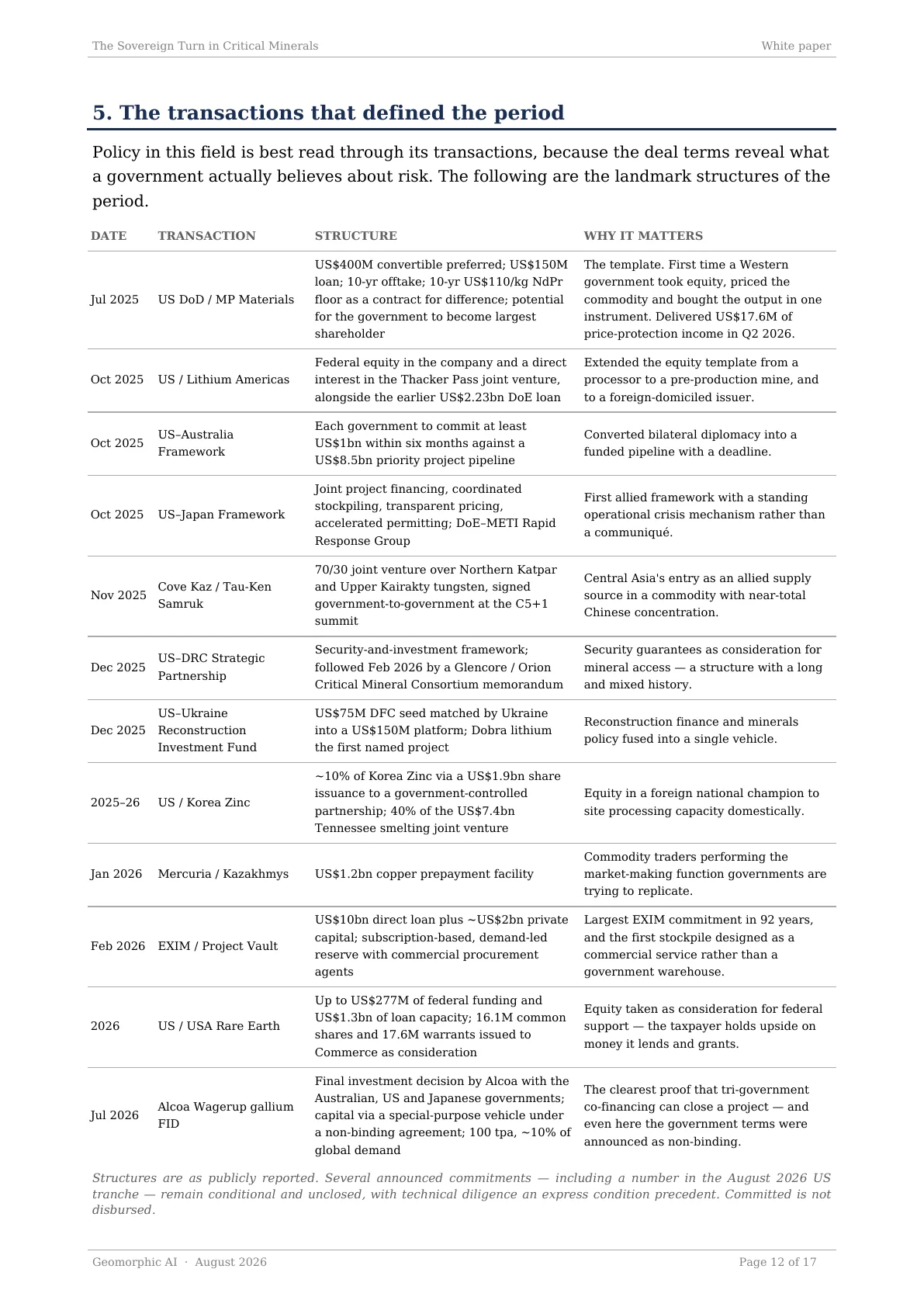
5. The transactions that defined the period
Policy in this field is best read through its transactions, because the deal terms reveal what
a government actually believes about risk. The following are the landmark structures of the
period.
DATE

Jul 2025

Oct 2025

Oct 2025

TRANSACTION

US DoD / MP Materials

US / Lithium Americas

US–Australia
Framework

STRUCTURE

WHY IT MATTERS

US$400M convertible preferred; US$150M

The template. First time a Western

loan; 10-yr offtake; 10-yr US$110/kg NdPr

government took equity, priced the

floor as a contract for difference; potential

commodity and bought the output in one

for the government to become largest

instrument. Delivered US$17.6M of

shareholder

price-protection income in Q2 2026.

Federal equity in the company and a direct

Extended the equity template from a

interest in the Thacker Pass joint venture,

processor to a pre-production mine, and

alongside the earlier US$2.23bn DoE loan

to a foreign-domiciled issuer.

Each government to commit at least
US$1bn within six months against a
US$8.5bn priority project pipeline
Joint project financing, coordinated

Oct 2025

US–Japan Framework

stockpiling, transparent pricing,
accelerated permitting; DoE–METI Rapid
Response Group
70/30 joint venture over Northern Katpar

Nov 2025

Cove Kaz / Tau-Ken

and Upper Kairakty tungsten, signed

Samruk

government-to-government at the C5+1
summit

Dec 2025

Dec 2025

US–DRC Strategic
Partnership

Converted bilateral diplomacy into a
funded pipeline with a deadline.

First allied framework with a standing
operational crisis mechanism rather than
a communiqué.

Central Asia's entry as an allied supply
source in a commodity with near-total
Chinese concentration.

Security-and-investment framework;

Security guarantees as consideration for

followed Feb 2026 by a Glencore / Orion

mineral access — a structure with a long

Critical Mineral Consortium memorandum

and mixed history.

US–Ukraine

US$75M DFC seed matched by Ukraine

Reconstruction

into a US$150M platform; Dobra lithium

Investment Fund

the first named project

Reconstruction finance and minerals
policy fused into a single vehicle.

~10% of Korea Zinc via a US$1.9bn share
2025–26

US / Korea Zinc

issuance to a government-controlled

Equity in a foreign national champion to

partnership; 40% of the US$7.4bn

site processing capacity domestically.

Tennessee smelting joint venture
Commodity traders performing the
Jan 2026

Mercuria / Kazakhmys

US$1.2bn copper prepayment facility

market-making function governments are
trying to replicate.

Feb 2026

EXIM / Project Vault

US$10bn direct loan plus ~US$2bn private

Largest EXIM commitment in 92 years,

capital; subscription-based, demand-led

and the first stockpile designed as a

reserve with commercial procurement

commercial service rather than a

agents

government warehouse.

Up to US$277M of federal funding and
2026

US / USA Rare Earth

US$1.3bn of loan capacity; 16.1M common
shares and 17.6M warrants issued to
Commerce as consideration
Final investment decision by Alcoa with the

Jul 2026

Alcoa Wagerup gallium
FID

Australian, US and Japanese governments;
capital via a special-purpose vehicle under
a non-binding agreement; 100 tpa, ~10% of
global demand

Equity taken as consideration for federal
support — the taxpayer holds upside on
money it lends and grants.

The clearest proof that tri-government
co-financing can close a project — and
even here the government terms were
announced as non-binding.

Structures are as publicly reported. Several announced commitments — including a number in the August 2026 US
tranche — remain conditional and unclosed, with technical diligence an express condition precedent. Committed is not
disbursed.

Geomorphic AI · August 2026

Page 12 of 17

The Sovereign Turn in Critical Minerals

White paper

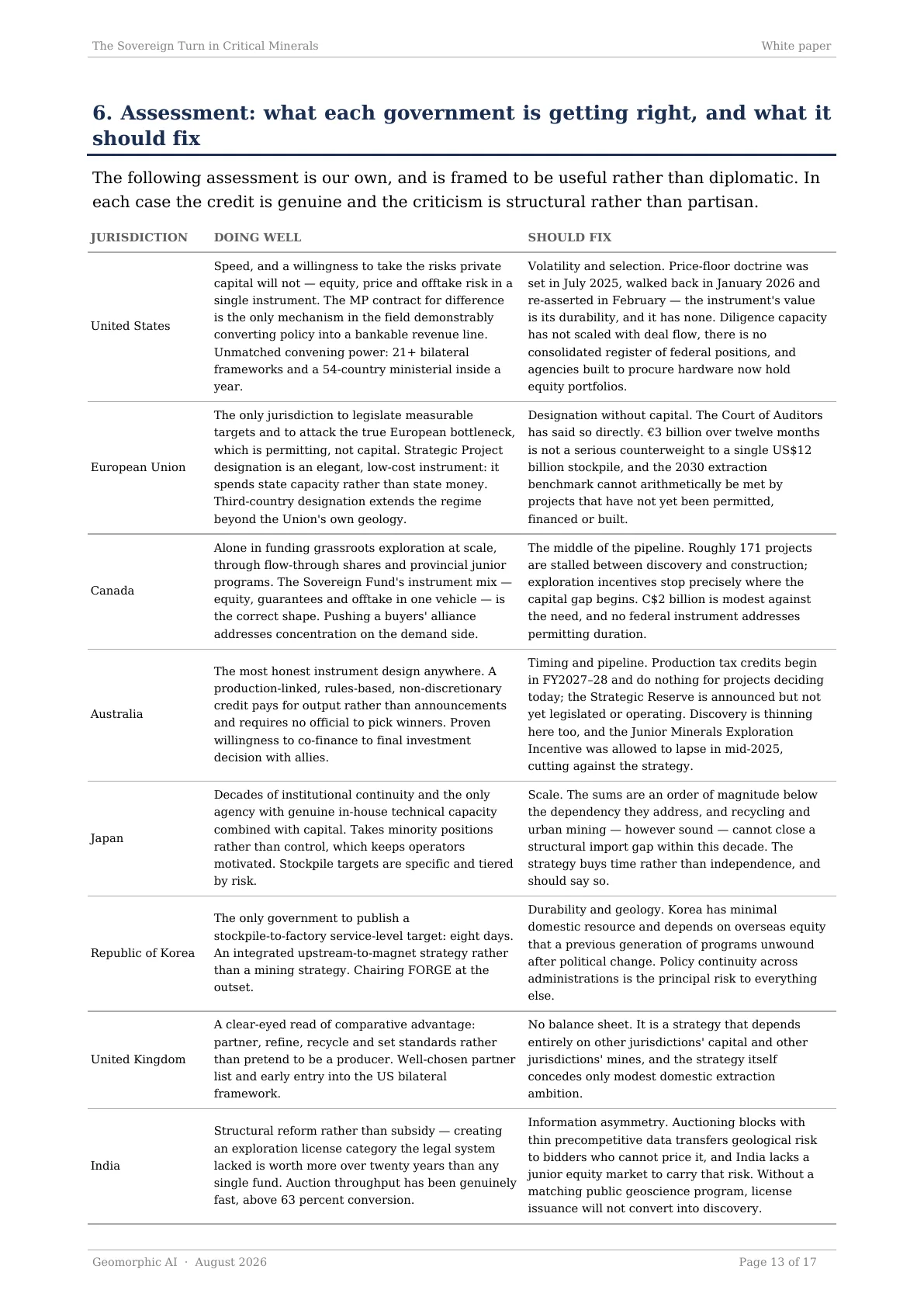
6. Assessment: what each government is getting right, and what it
should fix
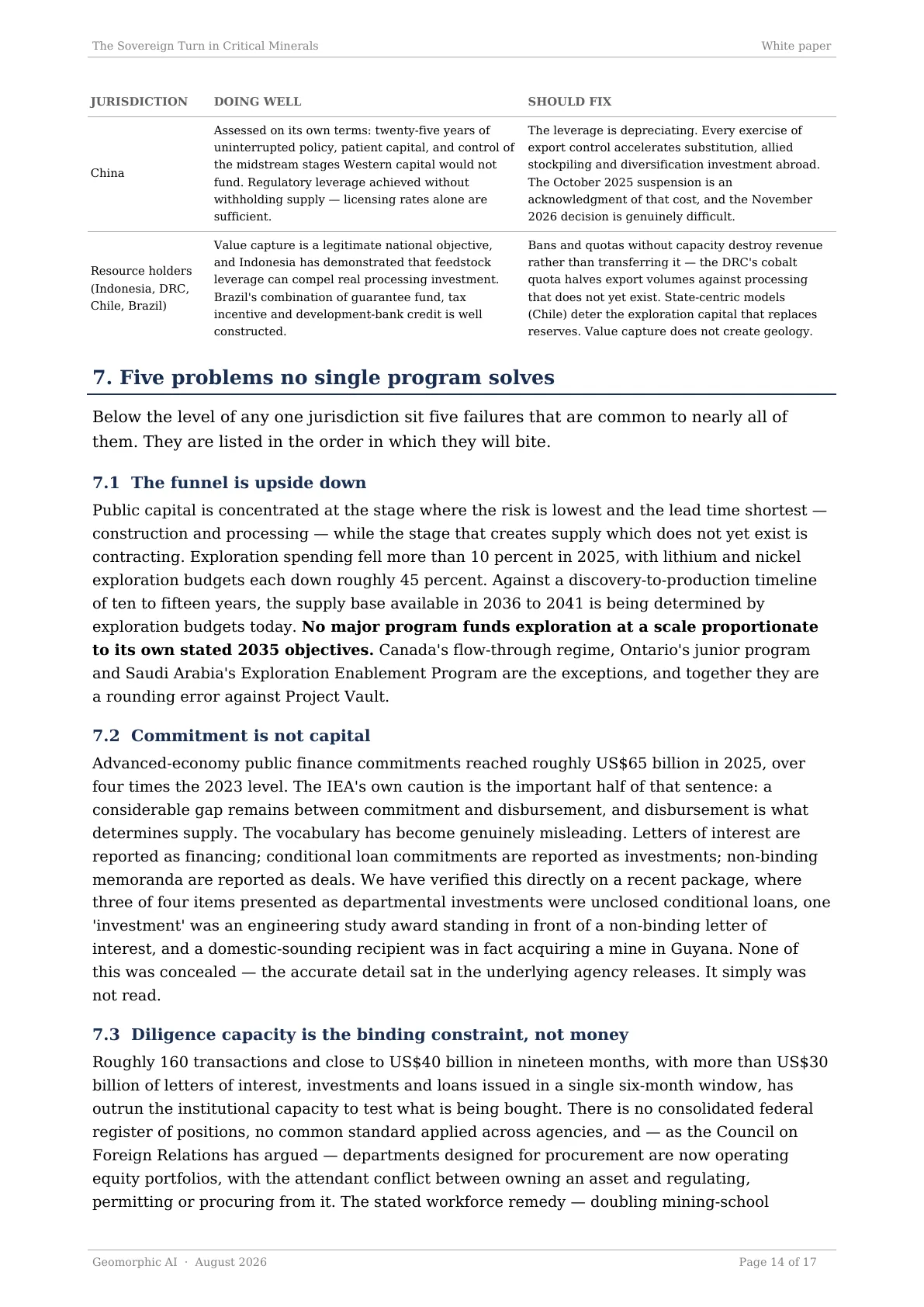
The following assessment is our own, and is framed to be useful rather than diplomatic. In
each case the credit is genuine and the criticism is structural rather than partisan.
JURISDICTION

United States

European Union

Canada

DOING WELL

SHOULD FIX

Speed, and a willingness to take the risks private

Volatility and selection. Price-floor doctrine was

capital will not — equity, price and offtake risk in a

set in July 2025, walked back in January 2026 and

single instrument. The MP contract for difference

re-asserted in February — the instrument's value

is the only mechanism in the field demonstrably

is its durability, and it has none. Diligence capacity

converting policy into a bankable revenue line.

has not scaled with deal flow, there is no

Unmatched convening power: 21+ bilateral

consolidated register of federal positions, and

frameworks and a 54-country ministerial inside a

agencies built to procure hardware now hold

year.

equity portfolios.

The only jurisdiction to legislate measurable

Designation without capital. The Court of Auditors

targets and to attack the true European bottleneck,

has said so directly. €3 billion over twelve months

which is permitting, not capital. Strategic Project

is not a serious counterweight to a single US$12

designation is an elegant, low-cost instrument: it

billion stockpile, and the 2030 extraction

spends state capacity rather than state money.

benchmark cannot arithmetically be met by

Third-country designation extends the regime

projects that have not yet been permitted,

beyond the Union's own geology.

financed or built.

Alone in funding grassroots exploration at scale,

The middle of the pipeline. Roughly 171 projects

through flow-through shares and provincial junior

are stalled between discovery and construction;

programs. The Sovereign Fund's instrument mix —

exploration incentives stop precisely where the

equity, guarantees and offtake in one vehicle — is

capital gap begins. C$2 billion is modest against

the correct shape. Pushing a buyers' alliance

the need, and no federal instrument addresses

addresses concentration on the demand side.

permitting duration.

The most honest instrument design anywhere. A
production-linked, rules-based, non-discretionary
Australia

credit pays for output rather than announcements
and requires no official to pick winners. Proven
willingness to co-finance to final investment
decision with allies.

Japan

yet legislated or operating. Discovery is thinning
here too, and the Junior Minerals Exploration
Incentive was allowed to lapse in mid-2025,
cutting against the strategy.
Scale. The sums are an order of magnitude below
the dependency they address, and recycling and

combined with capital. Takes minority positions

urban mining — however sound — cannot close a

rather than control, which keeps operators

structural import gap within this decade. The

motivated. Stockpile targets are specific and tiered

strategy buys time rather than independence, and

by risk.

should say so.

An integrated upstream-to-magnet strategy rather
than a mining strategy. Chairing FORGE at the
outset.

Durability and geology. Korea has minimal
domestic resource and depends on overseas equity
that a previous generation of programs unwound
after political change. Policy continuity across
administrations is the principal risk to everything
else.

A clear-eyed read of comparative advantage:

No balance sheet. It is a strategy that depends

partner, refine, recycle and set standards rather

entirely on other jurisdictions' capital and other

than pretend to be a producer. Well-chosen partner

jurisdictions' mines, and the strategy itself

list and early entry into the US bilateral

concedes only modest domestic extraction

framework.

ambition.

Structural reform rather than subsidy — creating
an exploration license category the legal system
India

today; the Strategic Reserve is announced but not

agency with genuine in-house technical capacity

stockpile-to-factory service-level target: eight days.

United Kingdom

in FY2027–28 and do nothing for projects deciding

Decades of institutional continuity and the only

The only government to publish a
Republic of Korea

Timing and pipeline. Production tax credits begin

lacked is worth more over twenty years than any
single fund. Auction throughput has been genuinely
fast, above 63 percent conversion.

Geomorphic AI · August 2026

Information asymmetry. Auctioning blocks with
thin precompetitive data transfers geological risk
to bidders who cannot price it, and India lacks a
junior equity market to carry that risk. Without a
matching public geoscience program, license
issuance will not convert into discovery.

Page 13 of 17

The Sovereign Turn in Critical Minerals

JURISDICTION

China

Resource holders
(Indonesia, DRC,
Chile, Brazil)

White paper

DOING WELL

SHOULD FIX

Assessed on its own terms: twenty-five years of

The leverage is depreciating. Every exercise of

uninterrupted policy, patient capital, and control of

export control accelerates substitution, allied

the midstream stages Western capital would not

stockpiling and diversification investment abroad.

fund. Regulatory leverage achieved without

The October 2025 suspension is an

withholding supply — licensing rates alone are

acknowledgment of that cost, and the November

sufficient.

2026 decision is genuinely difficult.

Value capture is a legitimate national objective,

Bans and quotas without capacity destroy revenue

and Indonesia has demonstrated that feedstock

rather than transferring it — the DRC's cobalt

leverage can compel real processing investment.

quota halves export volumes against processing

Brazil's combination of guarantee fund, tax

that does not yet exist. State-centric models

incentive and development-bank credit is well

(Chile) deter the exploration capital that replaces

constructed.

reserves. Value capture does not create geology.

7. Five problems no single program solves
Below the level of any one jurisdiction sit five failures that are common to nearly all of
them. They are listed in the order in which they will bite.

7.1 The funnel is upside down
Public capital is concentrated at the stage where the risk is lowest and the lead time shortest —
construction and processing — while the stage that creates supply which does not yet exist is
contracting. Exploration spending fell more than 10 percent in 2025, with lithium and nickel
exploration budgets each down roughly 45 percent. Against a discovery-to-production timeline
of ten to fifteen years, the supply base available in 2036 to 2041 is being determined by
exploration budgets today. No major program funds exploration at a scale proportionate
to its own stated 2035 objectives. Canada's flow-through regime, Ontario's junior program
and Saudi Arabia's Exploration Enablement Program are the exceptions, and together they are
a rounding error against Project Vault.

7.2 Commitment is not capital
Advanced-economy public finance commitments reached roughly US$65 billion in 2025, over
four times the 2023 level. The IEA's own caution is the important half of that sentence: a
considerable gap remains between commitment and disbursement, and disbursement is what
determines supply. The vocabulary has become genuinely misleading. Letters of interest are
reported as financing; conditional loan commitments are reported as investments; non-binding
memoranda are reported as deals. We have verified this directly on a recent package, where
three of four items presented as departmental investments were unclosed conditional loans, one
'investment' was an engineering study award standing in front of a non-binding letter of
interest, and a domestic-sounding recipient was in fact acquiring a mine in Guyana. None of
this was concealed — the accurate detail sat in the underlying agency releases. It simply was
not read.

7.3 Diligence capacity is the binding constraint, not money
Roughly 160 transactions and close to US$40 billion in nineteen months, with more than US$30
billion of letters of interest, investments and loans issued in a single six-month window, has
outrun the institutional capacity to test what is being bought. There is no consolidated federal
register of positions, no common standard applied across agencies, and — as the Council on
Foreign Relations has argued — departments designed for procurement are now operating
equity portfolios, with the attendant conflict between owning an asset and regulating,
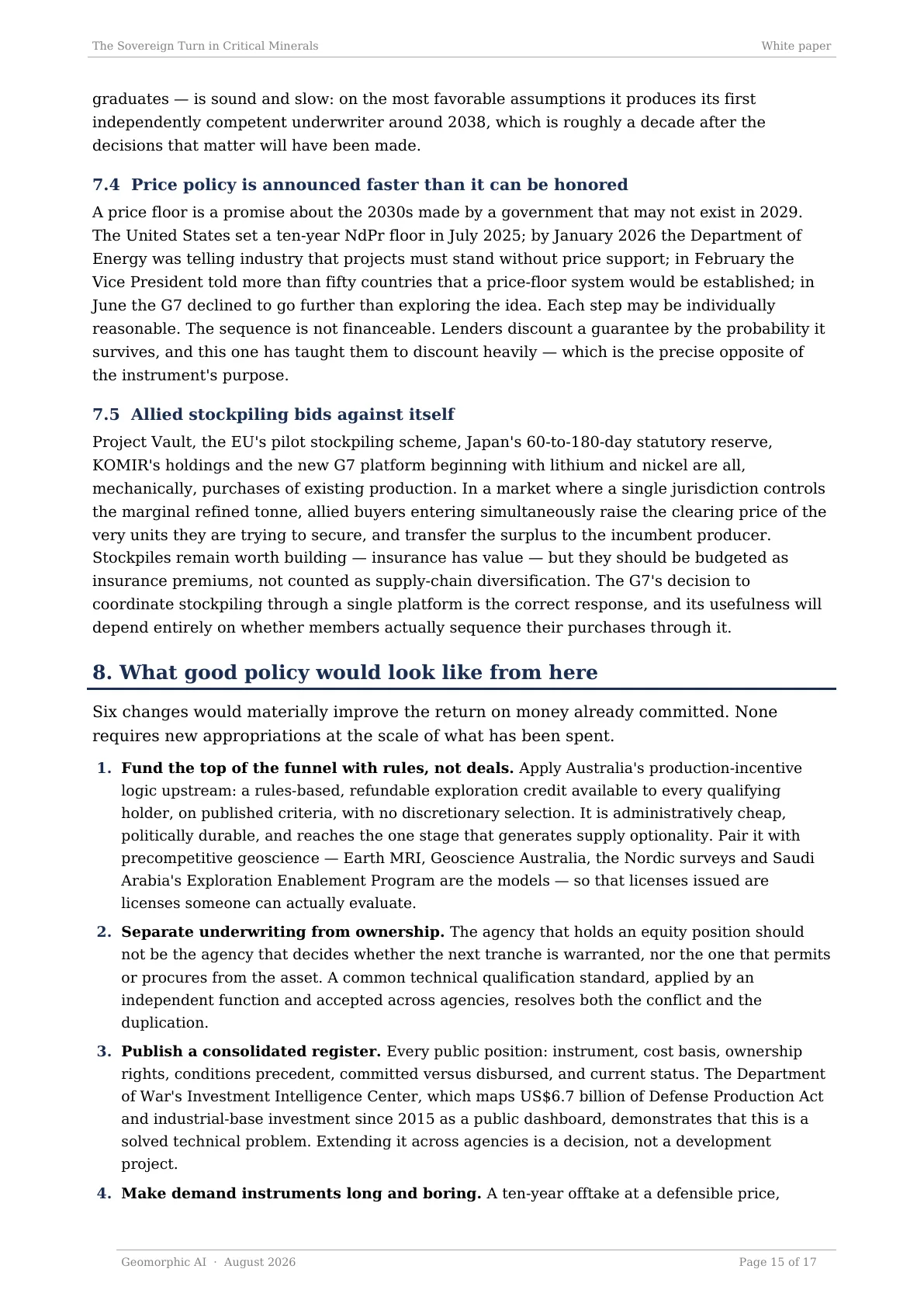
permitting or procuring from it. The stated workforce remedy — doubling mining-school

Geomorphic AI · August 2026

Page 14 of 17

The Sovereign Turn in Critical Minerals

White paper

graduates — is sound and slow: on the most favorable assumptions it produces its first
independently competent underwriter around 2038, which is roughly a decade after the
decisions that matter will have been made.

7.4 Price policy is announced faster than it can be honored
A price floor is a promise about the 2030s made by a government that may not exist in 2029.
The United States set a ten-year NdPr floor in July 2025; by January 2026 the Department of
Energy was telling industry that projects must stand without price support; in February the
Vice President told more than fifty countries that a price-floor system would be established; in
June the G7 declined to go further than exploring the idea. Each step may be individually
reasonable. The sequence is not financeable. Lenders discount a guarantee by the probability it
survives, and this one has taught them to discount heavily — which is the precise opposite of
the instrument's purpose.

7.5 Allied stockpiling bids against itself
Project Vault, the EU's pilot stockpiling scheme, Japan's 60-to-180-day statutory reserve,
KOMIR's holdings and the new G7 platform beginning with lithium and nickel are all,
mechanically, purchases of existing production. In a market where a single jurisdiction controls
the marginal refined tonne, allied buyers entering simultaneously raise the clearing price of the
very units they are trying to secure, and transfer the surplus to the incumbent producer.
Stockpiles remain worth building — insurance has value — but they should be budgeted as
insurance premiums, not counted as supply-chain diversification. The G7's decision to
coordinate stockpiling through a single platform is the correct response, and its usefulness will
depend entirely on whether members actually sequence their purchases through it.

8. What good policy would look like from here
Six changes would materially improve the return on money already committed. None
requires new appropriations at the scale of what has been spent.
1. Fund the top of the funnel with rules, not deals. Apply Australia's production-incentive
logic upstream: a rules-based, refundable exploration credit available to every qualifying
holder, on published criteria, with no discretionary selection. It is administratively cheap,
politically durable, and reaches the one stage that generates supply optionality. Pair it with
precompetitive geoscience — Earth MRI, Geoscience Australia, the Nordic surveys and Saudi
Arabia's Exploration Enablement Program are the models — so that licenses issued are
licenses someone can actually evaluate.
2. Separate underwriting from ownership. The agency that holds an equity position should
not be the agency that decides whether the next tranche is warranted, nor the one that permits
or procures from the asset. A common technical qualification standard, applied by an
independent function and accepted across agencies, resolves both the conflict and the
duplication.
3. Publish a consolidated register. Every public position: instrument, cost basis, ownership
rights, conditions precedent, committed versus disbursed, and current status. The Department
of War's Investment Intelligence Center, which maps US$6.7 billion of Defense Production Act
and industrial-base investment since 2015 as a public dashboard, demonstrates that this is a
solved technical problem. Extending it across agencies is a decision, not a development
project.
4. Make demand instruments long and boring. A ten-year offtake at a defensible price,

Geomorphic AI · August 2026

Page 15 of 17

The Sovereign Turn in Critical Minerals

White paper

legislated rather than announced, is worth more to a project's cost of capital than a headline
floor that can be withdrawn by the next administration. Where floors are used, they should be
capped, indexed to a published benchmark, and enacted — otherwise they are marketing.
5. Condition capital on stage-gated technical milestones. Resource confidence category,
metallurgical recovery on representative composites, tenure and surface-rights certainty,
permitting status. Release tranches against them. This is ordinary project-finance practice and
it is not being applied consistently to public money moving at this speed.
6. Multilateralize the underwriting, not only the money. The MSP Finance Network, the
Quad initiative, FORGE and the G7 alliance coordinate capital but not technical standards, so
the same project is diligenced repeatedly to different tests, or not at all. A shared qualification
standard, mutually recognized, would let one diligence pass unlock several balance sheets —
the single highest-leverage administrative reform available to the allied group.

9. Where Geomorphic fits
The gap this paper describes is not a capital gap. It is a gap between the volume of
decisions now being made and the technical capacity available to make them well. That is
the problem Geomorphic exists to solve.
Geomorphic AI is a technical-underwriting firm for mineral assets. We combine
machine-assisted screening of national geological, tenure, drilling and geochemical datasets
with experienced geological judgment, and we deliver conclusions as decision documents in
which every material claim is traceable to a primary source. We operate live cadastre and
dataset practice across roughly thirty jurisdictions — including the United States, Canada,
Finland, Sweden, Norway, Peru, Brazil, Guyana, Kazakhstan, Papua New Guinea, New Zealand
and Australia — which is to say, across the ground where the capital described in this paper is
actually being deployed. Five contributions follow directly from the findings above.
1. Independent technical underwriting at policy speed. Conditional commitments that name
technical satisfaction as a condition precedent need someone to satisfy it. We provide fast,
source-traceable reads on deposit quality, resource credibility, metallurgical risk and tenure
security, at the pace at which these programs are actually issuing term sheets — not at the
pace of a conventional twelve-week study.
2. Re-underwriting the book already committed. Close to US$40 billion has been committed
at speed, and nobody has systematically re-tested it. A retrospective portfolio screen —
instrument by instrument, orebody by orebody — identifies which positions carry geological
risk that was never priced. It blocks no deal and embarrasses no office, and it materially
reduces audit and oversight exposure. Public data is sufficient to begin.
3. Fact-sheet integrity. The gap between what is announced and what was actually committed
is now a reputational risk for the institutions doing the announcing. Reconciling public
statements against underlying agency releases and corporate disclosure is quick, cheap and
repeatedly finds material discrepancies — instrument type, jurisdiction, commodity, closed
versus conditional. We have done this on a live federal package and can evidence the method.
4. Origination against the commodities with no answer. Screening for supply gaps is not the
same as screening for deposits. We work the other direction: from the commodities where no
qualified Western project exists — scandium, refractory-grade bauxite, tantalum-niobium
feedstock, tungsten, antimony, germanium — back to specific open ground, historic drilling
and unworked datasets in accessible jurisdictions. This is the work that addresses Section 7.1
rather than restating it.

Geomorphic AI · August 2026

Page 16 of 17

The Sovereign Turn in Critical Minerals

White paper

5. Offshore capability where the mine capital is going. Public statements emphasize
domestic production; the deposit-level money has been flowing to Australia, Guyana,
Madagascar, Kazakhstan, Ukraine and the DRC. Agencies with foreign mandates — export
credit and development finance institutions in particular — typically carry thinner in-house
geological capacity than defense ministries do, while holding the assets that are hardest to
evaluate. That is the sharpest single mismatch in the system.

The argument in one line. Governments have spent nineteen months proving they can
move capital into critical minerals. The next nineteen will be spent discovering how much
of it was well spent. The institutions that can answer that question — quickly,
independently, and from primary sources — will shape the second phase of this policy far
more than the institutions that wrote the checks.

Method, sources and important notice
This paper is a desk review compiled in August 2026 from primary government sources —
White House, State Department, Department of War, Department of Energy, EXIM, DFC, the
European Commission and European Court of Auditors, Natural Resources Canada, the
Australian Department of Industry, Science and Resources and the Australian Taxation Office,
METI and JOGMEC, MOTIE and KOMIR, India's Ministry of Mines, Saudi Arabia's Ministry of
Industry and Mineral Resources, and the G7 and Quad communiqués — together with
International Energy Agency analysis, corporate disclosure, and secondary legal and consulting
commentary where primary material was unavailable. The United States Department of Defense
was renamed the Department of War during the period covered; both names appear here as
they were used at the time of the event described.
Figures are as reported at the date shown and are not adjusted to a common currency or date.
Where sources conflict on the size of a government equity position, the range is described
rather than a single figure asserted. Announced commitments are distinguished from closed
transactions wherever the underlying record supports the distinction; readers should assume
that any commitment described as conditional remains subject to financial, legal and technical
diligence and may not close. Programs in this field are changing weekly, and the expiry of
China's export-control suspension on 10 November 2026 is a foreseeable discontinuity that
would date parts of this analysis quickly.
This document is prepared for information and discussion. It is not investment advice, legal advice, or a recommendation
to buy, sell or hold any security, and it is not a solicitation for any transaction. Geomorphic AI Corporation is not a
registered investment adviser or broker-dealer. Assessments in Sections 6 to 8 are the author's opinion. No
representation or warranty, express or implied, is given as to the accuracy or completeness of third-party information
relied upon.

Geomorphic AI · August 2026

Page 17 of 17